

Special Steel Casting
Our goal is to become your true partner in the field of aluminum alloy casting in China. SRIF is engaged in the R&D, promotion and production of new foundry materials, processes, techniques and equipment. The factory has accumulated rich manufacturing experience. Our company is committed to applying advanced manufacturing technology and strict quality control standards to every product. The price is competitive and the product is quality-assured, which is a good choice for your long-term cooperation.
Why Choose Us
Product Application
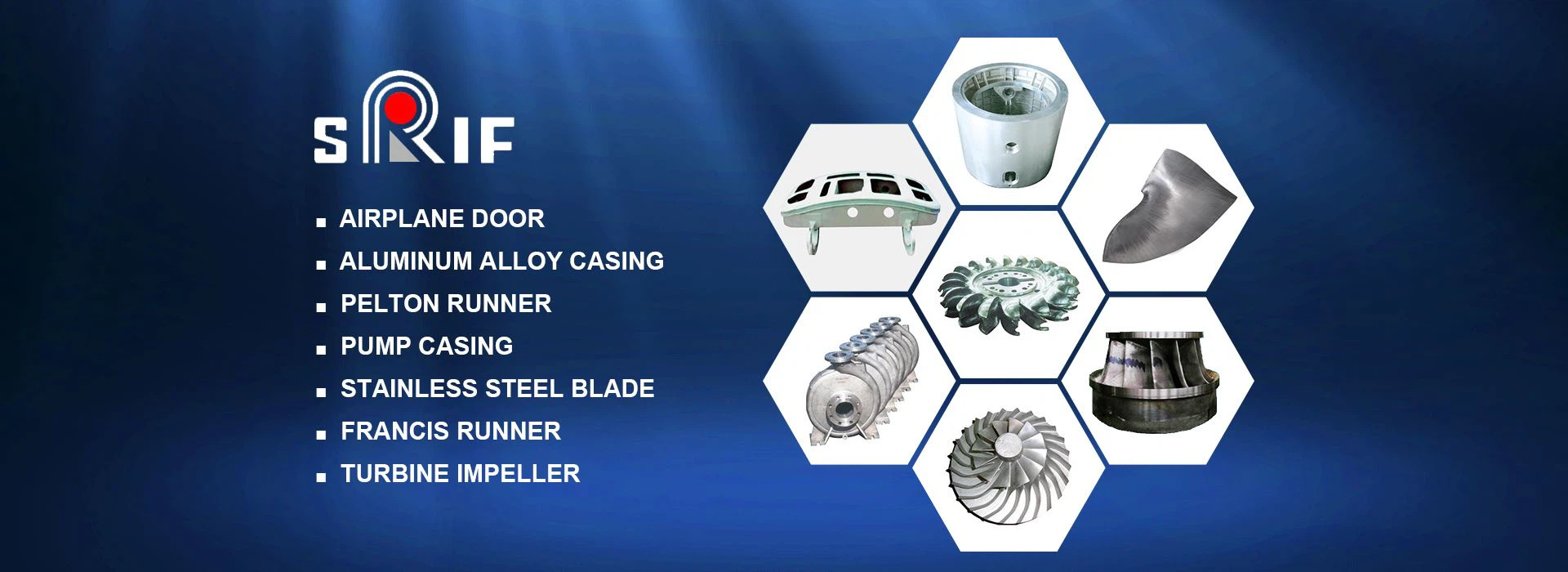
SRIF specializes in the production of special steel castings, electro-slag remelting castings, aluminum alloy castings and so on. Our high-quality castings are widely applied in the development of airspace and aerospace equipment, and construction of hydraulic power stations at home and abroad. We boast a complete range of quality management systems.
Our Team
SRIF have are 519 employees at SRIF including over 200 technical staffers, 144 researchers and senior engineers, 124 doctors and masters, together with a number of foundry academic leaders.
Our Service
The company has a professional sales team to provide you with high-quality pre-sales consulting services. During the order production process, customers can communicate with us at any time to understand the production progress. At the same time, we provide high-quality after-sales service to meet the different needs of customers.
-
 Stainless Steel BladeThe stainless steel blade for Francis runner, ready to be assembled, is produced with sand castingAdd to Inquiry
 -
 Monobloc Stainless Steel Pelton RunnerMaterial: ASTM A743 Gr CA6NM, ZG0Cr13Ni4Mo (ZG0Cr13Ni5Mo ZG0Cr16Ni5Mo, etc.) AOD refined stainlessAdd to Inquiry
 -
 Electro-slag Remelting Casting(ESRC) Wicket GateMaterial: ASTM A743 Gr CA6NM, ZG0Cr13Ni4Mo (ZG0Cr13Ni5Mo ZG0Cr16Ni5Mo etc.) stainless steel.Add to Inquiry
 -
 Stainless Steel Francis RunnerThe crown, the band and the blades are sand cast and machined separately before being integratedAdd to Inquiry
 -
 Monobloc Cast Francis RunnerIn our monobloc casting processes, 3D printed sand mold is used so that the crown, the band and theAdd to Inquiry
 -
 Electro-slag Remelting Casting(ESRC) CrankshaftElectro-slag remelting casting developed by SRIF is adopted instead of forging to manufacture thisAdd to Inquiry
 -
 Electro-slag Remelting Casting(ESRC) Guide VanesThe guide vanes are used on large sized hydraulic power generators. Possible materials includeAdd to Inquiry
 -
 Electro-slag Remelting Casting(ESRC) Torsion AxisESRC (electro-slag remelting casting) torsion axis for 5 MW wind power generator, produced at lowerAdd to Inquiry
 -
 Electro-slag Remelting CastingMaterial: ASTM A743 Gr CA6NM, ZG0Cr13Ni4Mo (ZG0Cr13Ni5Mo ZG0Cr16Ni5Mo etc.) stainless steel.Add to Inquiry


- Tel: +86-024-25872276
- Fax: +86-024-25872276
- Email: srif@chinasrif.com
- Add: 17 South Yunfeng Street, Tiexi District, Shenyang P.R. China
Types of Special Steel Casting
The speciality paper produced by our company mainly include the following types:
Stainless Steel Francis Runner
The crown, the band and the blades are sand cast and machined separately before being integrated into a whole by welding. We are capable of manufacturing crowns, bands or blades weighing not more than 6000 kg individually. The products can be delivered as cast, semi-machined, or machined.
Electro-slag Remelting Casting(ESRC) Wicket Gate
The result of ultrasonic tests proves to meet the requirement of CCH70-3 and the highest level of ASTM A609, 1-2 levels higher than the result of sand mold castings. Cavitation resistance is increased by 30% compared with sand mold castings. Metal mold casting process creates less environmental pollution.
Electro-slag Remelting Casting(ESRC) Guide Vanes
The guide vanes are used on large sized hydraulic power generators. Possible materials include 20SiMn, Q345C carbon steel, low-alloy steel, as well as stainless steel. Fixed guide vanes for hydraulic power stations are manufactured with electro-slag remelting casting technology here at SRIF, instead of the traditional production method with steel slabs. Guide vanes of superior quality and higher stiffness can thus be produced with much lower costs, and within a shorter production cycle.
Advantages of Special Steel Casting
Stainless steel francis runner have many advantages, including:
High efficiency and reliability: Our stainless steel francis runner is designed to provide efficient energy conversion with an efficiency rate of 89% to 95%, ensuring a reliable source of power for your renewable energy needs.
Wide range of applications: With a capacity of 100kw to 50 kw, this generator is suitable for various applications, including residential, commercial, and industrial use, as specified by the user.
Durable construction: Constructed from high-quality stainless steel, our francis turbine is built to withstand harsh environments and last for a long time.
Multi-frequency compatibility: This generator is designed to operate at both 50hz and 60hz frequencies, making it compatible with various power systems worldwide.
Certified quality: Our product meets the iso 9001 standard, ensuring that it meets international quality and safety requirements, providing peace of mind for our customers.
Electro-slag remelting casting(esrc) wicket gate have many advantages, including:
Progressive solidification and self padding: The density of final products is much higher than that of sand mold castings.
Slag refining: The sulfur content and other impurities are reduced and the toughness, fatigue resistance and welding ability is higher than those of sand mold castings.
Electro-slag remelting casting(esrc) guide vanes have many advantages, including: ESR is shown to lead to a high yield of alloying elements, low levels of impurities and non-metallic inclusions (NMIs) and a refinement of the final microstructures due to slight changes in the chemical composition.
Application of Special Steel Casting
Stainless Steel Francis Runner
Stainless steel francis runner can be used for a variety of purposes, including: This is the most efficient hydraulic turbine. The large stainless steel francis runner is individually designed for the site to operate at the highest possible efficiency, typically over 90%. Francis-type units cover a wide head range, from 20 to 700 m and their output varies from a few kilowatts to 200 megawatts. In addition to electrical products and they May also be used for pumped storage; where reservoir is filled by the turbine (acting as a pump) during low power demand, and then reversed and used to generate power during peak demand.


Electro-slag Remelting Casting(ESRC) Wicket Gate
Electro-slag remelting casting(esrc) wicket gate can be used for a variety of purposes, including:
Electroslag remelting (ESR), also known as electro-flux remelting, is a process of remelting and refining steel and other alloys for mission-critical applications in aircraft, thermal power stations, nuclear power plants, military technology and others.
Electro-slag Remelting Casting(ESRC) Guide Vanes
Electro-slag remelting casting(esrc) guide vanes can be used for a variety of purposes, including:
Electro-slag remelting casting(esrc) guide vanes is a process of remelting and refining steel and other alloys for mission-critical applications in aircraft, thermal power stations, nuclear power plants, military technology and others.

Cast Steel Grades and Properties of Stainless Steel Francis Runnerc
|
Cast Steel ZG06Cr13Ni4-6Mo |
||||||
|
Composition |
C |
Cr |
Ni |
Mo |
Si |
Mn |
|
Mechanical Properties |
Re(MPa) |
Rm(MPa) |
A(%) |
Z(%) |
Kv(J) |
HB |
|
Application |
Applicable to flow parts for hydraulic turbines, petroleum, chemical engineering, marine engineering, cooling, ship building, paper processing, and food processing industries. |
|||||
|
Cast Steel ZG00Cr13Ni5Mo |
||||||
|
Composition |
C |
Cr |
Ni |
Mo |
Si |
Mn |
|
Mechanical Properties |
Re(MPa) |
Rm(MPa) |
A(%) |
Z(%) |
Kv(J) |
HB |
|
Application |
Applicable to flow parts for hydraulic turbines, petroleum, chemical engineering, marine engineering, cooling, ship building, paper processing, and food processing industries. |
|||||
|
Cast Steel ZG30Cr16Ni4-15 |
||||||
|
Composition |
C |
Cr |
Ni |
Mo |
Si |
Mn |
|
Mechanical Properties |
Re(MPa) |
Rm(MPa) |
A(%) |
Z(%) |
Kv(J) |
HB |
|
Application |
Metallurgy, smelting and sintering industries, working temperature 900 -1100℃. |
|||||
Specification of Electro-slag Remelting Casting(ESRC) Wicket Gate
|
Material |
ASTM A743 Gr CA6NM, ZG0Cr13Ni4Mo (ZG0Cr13Ni5Mo ZG0Cr16Ni5Mo etc.) stainless steel |
|
Production method |
AOD refining+ electro-slag remelting casting |
|
Individual net weight |
150~30000 kg |
|
Delivery state |
As cast, semi-machined, machined |
Precautions for Use Stainless Steel Francis Runner
Using a runner with a low specific speed can also help avoid cavitation. The turbine can operate without encountering cavitation issues by selecting a runner design that matches the specific speed requirements.
Designing a cavitation-free runner requires extensive research and optimization. Cavitation can be effectively avoided by carefully engineering the runner to meet specific conditions.
Reducing cavitation effects can be achieved by polishing the runner's surface. Coating cast steel runners and blades with stainless steel enhances their resistance to cavitation.
Choosing materials with better resistance to cavitation can reduce its effects. Cast steel is preferable to cast iron, and stainless steel or alloy steel provides even greater resistance against cavitation.
Selecting a runner with the appropriate specific speed for the given head helps in preventing cavitation. Proper matching of specific speed ensures smooth turbine operation without encountering cavitation-related challenges.
Packaging and Shipping of Special Steel Casting
|
Shipping |
Air, Land, Sea |
|
Packaging Details |
Stainless Steel Export Packing |
FAQ
As one of the most professional special steel casting manufacturers and suppliers in China, we're featured by premium investment castings with competitive price. Please rest assured to buy high quality customized special steel casting from our factory. Contact us for quotation.
Electro slag Remelting Casting Crankshaft, Stainless Steel Francis Runner, Stainless Steel Blade