

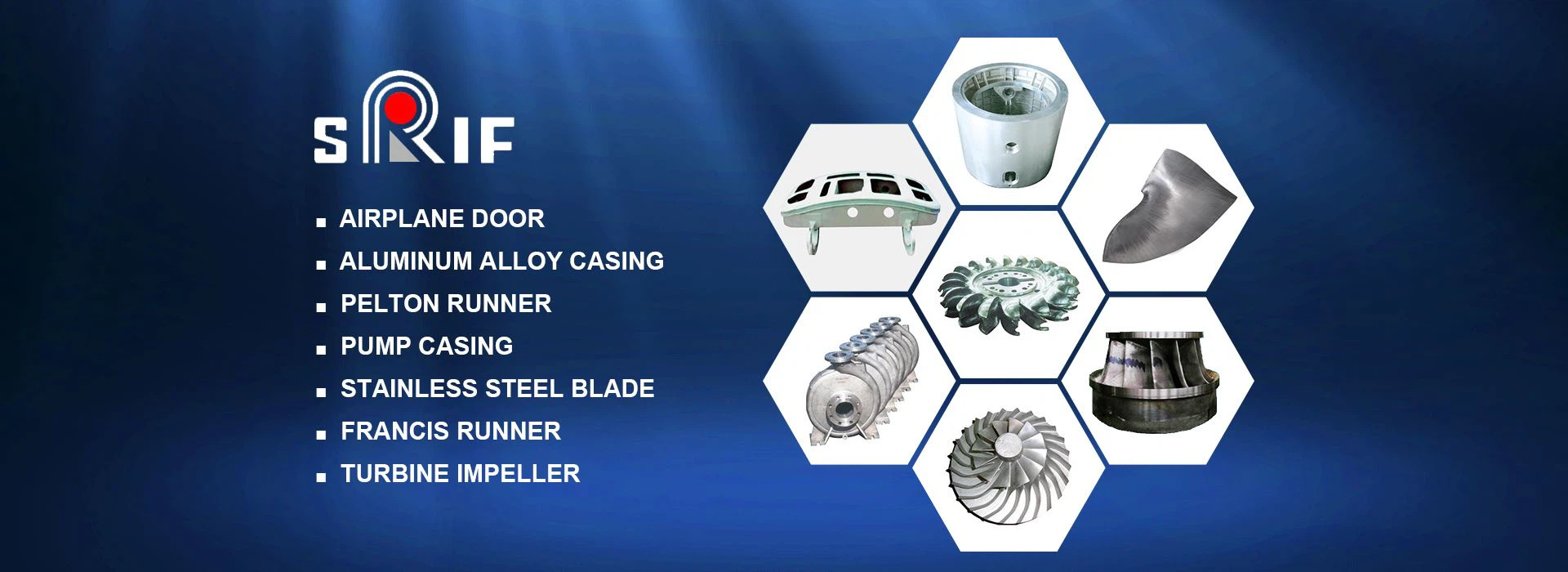
Aluminum Alloy Casting
Our goal is to become your true partner in the field of aluminum alloy casting in China. SRIF is engaged in the R&D, promotion and production of new foundry materials, processes, techniques and equipment. The factory has accumulated rich manufacturing experience. Our company is committed to applying advanced manufacturing technology and strict quality control standards to every product. The price is competitive and the product is quality-assured, which is a good choice for your long-term cooperation.
Why Choose Us
Product Application
SRIF specializes in the production of special steel castings, electro-slag remelting castings, aluminum alloy castings and so on. Our high-quality castings are widely applied in the development of airspace and aerospace equipment, and construction of hydraulic power stations at home and abroad. We boast a complete range of quality management systems.
Our Team
SRIF have are 519 employees at SRIF including over 200 technical staffers, 144 researchers and senior engineers, 124 doctors and masters, together with a number of foundry academic leaders.
Our Service
The company has a professional sales team to provide you with high-quality pre-sales consulting services. During the order production process, customers can communicate with us at any time to understand the production progress. At the same time, we provide high-quality after-sales service to meet the different needs of customers.
-
 Airplane DoorDimension: 650×350×100mm. Casting section thickness: 2mm. Alloy: D357. Quality: Internal qualityAdd to Inquiry
 -
 Al Alloy CastingOuter dimension: ∅5200mm*1100. Weight: 5100 kg. Alloy: ZL114A. Casting method: gravity casting.Add to Inquiry
 -
 Alluminum Alloy CastingDimension: 956×613×274mm. Alloy: ZL401A. Qualification: Mechanical properties as cast reachAdd to Inquiry
 -
 Low Pressure Al Alloy CastingDimension: 2280×1610×1100mm. Alloy: ZL102. Quality: able to work at 150℃, no leak under 0.5MpaAdd to Inquiry
 -
 Al Alloy Upper CasingWeight:54 kg. Alloy:ZAlSi7Mg0.3. Casting method:Low pressure casting. Mechanical properties: Rm≥Add to Inquiry
 -
 Al Alloy RingOuter dimension: φ2780×300 mm. Weight: 1800 kg. Alloy: ZL114A. Casting method: Gravity casting .Add to Inquiry
 -
 High Strength Al Alloy CastingDimension: 956×613×274mm. Alloy: ZL401A. Qualification: Mechanical properties as cast reachAdd to Inquiry
 -
 Large Al Alloy CastingDimension: 2280×1610×1100mm. Alloy: ZL102. Quality: able to work at 150℃, no leak under 0.5MpaAdd to Inquiry
 -
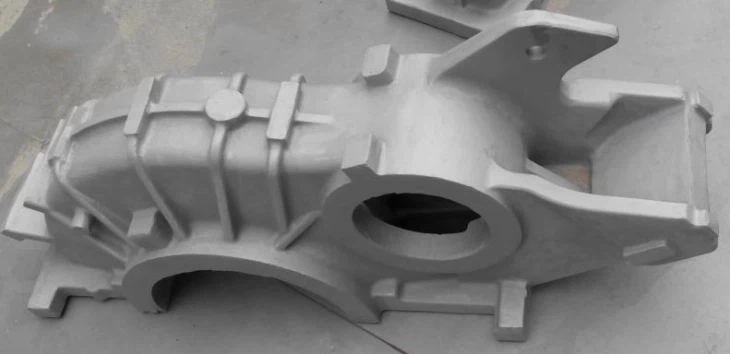 Upper Casing Aluminum Alloy CastingWeight: 54 kg. Alloy: ZAlSi7Mg0.3. Casting method: Low pressure casting. Mechanical properties: Rm≥Add to Inquiry
 -
 Al Alloy CastingsOuter dimension: φ2780×300 mm. Weight: 1800 kg. Alloy: ZL114A. Casting method: Gravity casting.Add to Inquiry


- Tel: +86-024-25872276
- Fax: +86-024-25872276
- Email: srif@chinasrif.com
- Add: 17 South Yunfeng Street, Tiexi District, Shenyang P.R. China
Advantages of Aluminum Alloy Casting
Lightweight And Strong: Aluminum is a lightweight and strong material that is highly valued in various industries. Aluminum alloy casting allows for the production of lightweight parts with high strength-to-weight ratios.
High Precision: The die casting process produces highly accurate and precise parts with tight tolerances. This means that the parts produced through die casting require minimal or no post-processing, reducing the time and cost of production.
Excellent Surface Finish: Aluminum alloy casting produces parts with a smooth and uniform surface finish. This eliminates the need for additional surface finishing processes, such as sandblasting or painting, which can be time-consuming and costly.
Versatility: Aluminum alloy casting can produce parts of various shapes and sizes, making it a versatile manufacturing process. This allows manufacturers to create complex parts with intricate details that would be difficult or impossible to produce using other manufacturing processes.
Cost-effective: Aluminum alloy casting is a cost-effective manufacturing process due to its high production efficiency, minimal post-processing requirements, and the ability to produce parts with high precision and accuracy.
Durability: Aluminum alloy casting produces parts that are highly durable and resistant to corrosion, making them ideal for use in harsh environments or applications where parts are subjected to high stress or wear.
Application of Aluminum Alloy Casting

Automotive Industry: In the automotive industry, aluminum die casting is ideal to use due to its properties like durability and lightweight alternative to steel and iron. Moreover, its lightweight feature makes it an excellent choice for transportable applications.
Renewable Energy: In some parts, aluminum die casting is used for power generation and distribution equipment in the renewable energy industry. The process of aluminum die casting is used.
Aerospace: In the aerospace industry, aircraft demand components that can offer up-to-the-mark performance. Aluminum die castings are excellent for aircraft as they are lightweight, highly durable, and affordable as they can withstand harsh operating and environmental conditions and have better fuel efficiency.
Agriculture Sector: Aluminum die castings can be utilized in several machines like combine harvesters or tractors in the agricultural industry.
Industrial Equipment: Aluminum die castings are also used for multiple components of equipment and systems in the industrial machinery & equipment industry. For instance, die-cast equipment components cover connecting rods, bearings, and pistons.
MEDICAL INDUSTRY: Die-cast aluminum parts can be seen used in various devices and systems used in the medical industry. From diagnostic and treatment equipment to beds and surgical instruments, such productions are integrated into almost everything.

Specifications for Aluminum Alloy Casting
|
Dimension |
956×613×274mm/Custom |
|
Qualification |
Mechanical properties as cast reach σb≥241MPa, δ≥1.5%. Dimensional precision conforms to CT8 of HBG03-86 |
|
Casting Method |
Low pressure casting |
Precautions for Use Aluminum Alloy Casting
The first thing that should be done is the equipment inspection work before casting. Strictly check whether there are any abnormalities in various parts of the equipment, including whether the operating platform is firm and firm; if the water cooling system is smooth, etc., with these tasks, you can effectively avoid the operation process. Possible emergency due to equipment failure.
Secondly, it is necessary to pay attention to the safety of personnel operations in the casting process. On the one hand, companies are required to take certain safety precautions to reduce the losses caused by possible accidents. On the other hand, operators are also required to pay attention to the operating conditions of the equipment. Appropriate handling of emergencies that may occur, to the greatest extent possible to avoid the harm caused by the accident.
Finally, when the casting is completed, the water cooling system should be shut down in time to prevent unnecessary damage to the equipment and bury hidden safety hazards.
The surface finish of a die casting is critical for both aesthetic and functional reasons. A smooth surface can improve the part’s appearance and reduce the risk of corrosion or wear, while a rough surface can affect the part’s performance and reduce its lifespan.
To achieve the desired surface finish, pls consider factors such as the mold material, the injection pressure, and the mold temperature. Additionally, it may be necessary to incorporate features such as ejector pins, vents, or overflow channels to prevent air pockets or other defects that could affect the surface finish.
Aluminum Alloys Casting Material
Al Si Alloy: Also known as "Silicon Aluminum Ming" or "Silicon Aluminum Ming". It has good castability and wear resistance, and has a small coefficient of thermal expansion. It is the alloy with the most varieties and the largest amount among the cast aluminum alloys, with a silicon content of 10% - 25%. Sometimes 0.2% - 0.6% magnesium.
Aluminum Copper Alloy: The alloy containing 4.5% - 5.3% copper has the best strengthening effect. The appropriate addition of manganese and titanium can significantly improve the room temperature, high temperature strength and casting properties.
Aluminum Zinc Alloy: In order to improve performance, silicon and magnesium are often added, which is often called "zinc silicon aluminum Ming". Under casting conditions, the alloy has quenching effect, namely "self quenching". It can be used without heat treatment, so the castings have higher strength after modification heat treatment.
Aluminum Magnesium Alloy: The casting aluminum alloy with the lowest density (2.55g/cm3) and the highest strength (about 355MPa) contains 12% magnesium, and the strengthening effect is the best.
Packaging and Shipping of Aluminum Alloy Casting
|
Packing |
Cardboard packaging+reinforced cardboard packaging placed on a pallet |
|
Shipping |
Air, Land, Sea |
FAQ
As one of the most professional aluminum alloy casting manufacturers and suppliers in China, we're featured by premium investment castings with competitive price. Please rest assured to buy high quality customized aluminum alloy casting from our factory. Contact us for quotation.
Upper Casing Aluminum Alloy Casting, Al Alloy Castings, Al Alloy Upper Casing