

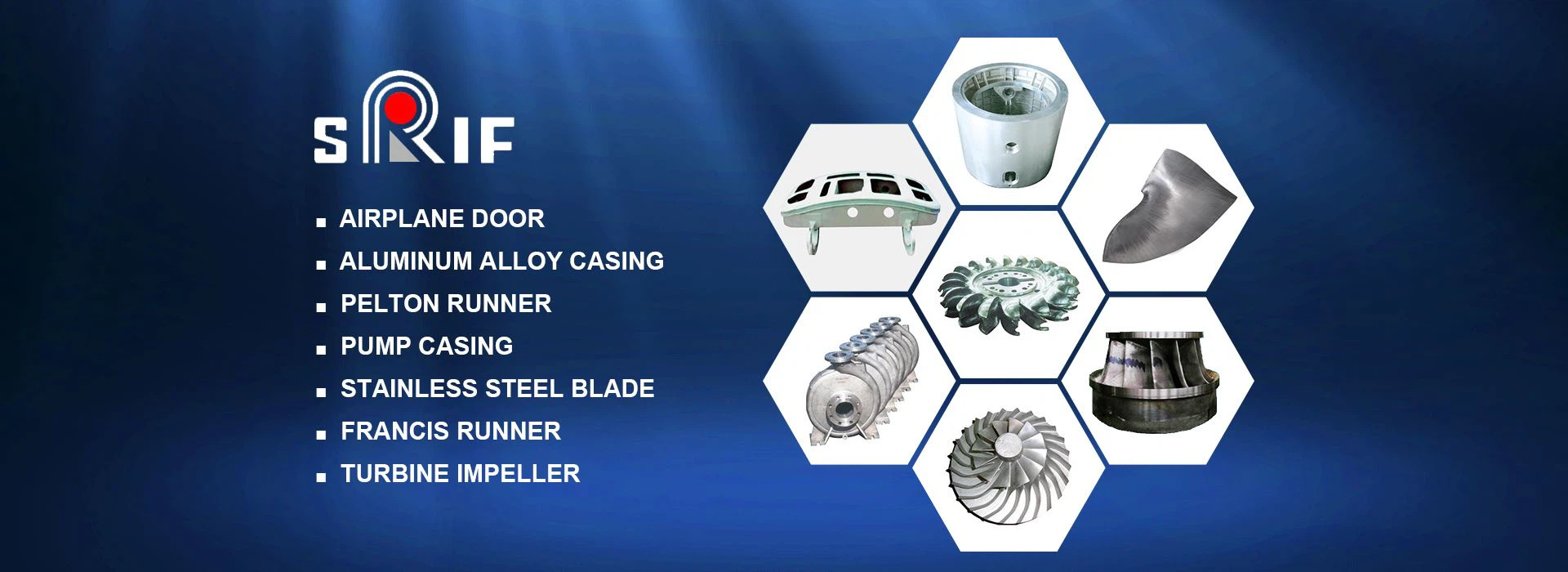
Casting
Our goal is to become your true partner in the field of aluminum alloy casting in China. SRIF is engaged in the R&D, promotion and production of new foundry materials, processes, techniques and equipment. The factory has accumulated rich manufacturing experience. Our company is committed to applying advanced manufacturing technology and strict quality control standards to every product. The price is competitive and the product is quality-assured, which is a good choice for your long-term cooperation.
Why Choose Us
Product Application
SRIF specializes in the production of special steel castings, electro-slag remelting castings, aluminum alloy castings and so on. Our high-quality castings are widely applied in the development of airspace and aerospace equipment, and construction of hydraulic power stations at home and abroad. We boast a complete range of quality management systems.
Our Team
SRIF have are 519 employees at SRIF including over 200 technical staffers, 144 researchers and senior engineers, 124 doctors and masters, together with a number of foundry academic leaders.
Our Service
The company has a professional sales team to provide you with high-quality pre-sales consulting services. During the order production process, customers can communicate with us at any time to understand the production progress. At the same time, we provide high-quality after-sales service to meet the different needs of customers.
-
 Airplane DoorDimension: 650×350×100mm. Casting section thickness: 2mm. Alloy: D357. Quality: Internal qualityAdd to Inquiry
 -
 Mg Alloy CastingDimension: Φ700×500mm. Alloy: ZM5. Quality: Internal quality conforms to class Ⅱ of HB965-84 byAdd to Inquiry
 -
 Ti Alloy ImpellerThis titanium impeller casting is widely used in pumps and valves for the chemical industry. TheAdd to Inquiry
 -
 Ti Alloy Pump CasingThe pump casing is manufactured with TA2 pure titanium, a type of material excellent inAdd to Inquiry
 -
 Ti Alloy Turbine ImpellerThe turbine impeller is made from TC4 titanium alloy. TC4 titanium alloy boasts outstandingAdd to Inquiry
 -
 Ti Alloy Aerospace Investment CastingsThese transmission system components of turbofan engine, including holders and end covers, haveAdd to Inquiry
 -
 Stainless Steel BladeThe stainless steel blade for Francis runner, ready to be assembled, is produced with sand castingAdd to Inquiry
 -
 Monobloc Stainless Steel Pelton RunnerMaterial: ASTM A743 Gr CA6NM, ZG0Cr13Ni4Mo (ZG0Cr13Ni5Mo ZG0Cr16Ni5Mo, etc.) AOD refined stainlessAdd to Inquiry
 -
 Electro-slag Remelting Casting(ESRC) Wicket GateMaterial: ASTM A743 Gr CA6NM, ZG0Cr13Ni4Mo (ZG0Cr13Ni5Mo ZG0Cr16Ni5Mo etc.) stainless steel.Add to Inquiry
 -
 Al Alloy CastingOuter dimension: ∅5200mm*1100. Weight: 5100 kg. Alloy: ZL114A. Casting method: gravity casting.Add to Inquiry
 -
 Alluminum Alloy CastingDimension: 956×613×274mm. Alloy: ZL401A. Qualification: Mechanical properties as cast reachAdd to Inquiry
 -
 Low Pressure Al Alloy CastingDimension: 2280×1610×1100mm. Alloy: ZL102. Quality: able to work at 150℃, no leak under 0.5MpaAdd to Inquiry


- Tel: +86-024-25872276
- Fax: +86-024-25872276
- Email: srif@chinasrif.com
- Add: 17 South Yunfeng Street, Tiexi District, Shenyang P.R. China
Advantages of Casting
Complex Shapes And Geometries: The casting process can create complex shapes and features with deatling. For example, internal channels and cavities, undercuts, thin walls, hollow sections, multi-part assemblies, asymmetric geometries, etc.
Versatility In Materials: It can work with a variety of metals and alloys, ferrous and non-ferrous. Some examples include iron, steel, zinc, copper, aluminum, and lead alloys. Consequently, extensive material versatility gives the flexibility to choose the optimal material that fulfills the desired properties.
Cost-effectiveness: Sand and other expandable mold casting are cost-effective for small volumes or prototypes. On the other hand, permanent die or mold casting methods are adaptable for large-scale manufacturing as one-time tooling costs can cover up to millions of cycles.
Size Range: Any size of parts is castable, from a few hundred grams to 200+ tons. For example, a small motorcycle engine block to large to large steam turbine housing and base for industrial equipment.
High Strength And Durability: The controlled cooling process to solidify the mold ensures uniform grain structure and maintains the same mechanical properties (strength and toughness) across all directions.
Reduced Waste: The material waste from the sprue, intake gate, and runner can be reused in subsequent cycles or batches by re-melting them.
Application of Casting

Automotive Industry: The diversity of casting applications in the automotive industry can be seen from the fact that “ the die-cast method was initially invented to manufacture complex automotive zinc parts.”
Aerospace Industry: The casting methods can process lightweight materials like nickel-based super alloys, aluminum alloys, and magnesium alloys into complex aerospace components. Meanwhile, the controlled cooling and solidification enhance their properties.
Consumer Goods: The ability to make complex designs such as ornate decor, detailed kitchen utensils, and durable cookware makes it suitable for many consumer goods. Techniques like investment, die, lost foam and sand casting manufacture these items.
Industrial Equipment And Machinery: Casting manufacturing maintains the original properties of raw materials and can even increase them by adding fillers and additives. Consequently, sand, die, and other casting molds can shape high-strength and corrosion-resistant alloys like stainless steel, carbon alloys, and aluminum.
Medical Devices: The biocompatible materials chromium, titanium, zirconium, and titanium alloys can also be cast precisely using different techniques.
Energy Sector: The casting of high-strength materials like stainless steel, magnesium, aluminum, and zinc alloys can create components and products for the energy sector that withstand high stress and harsh chemical and environmental conditions.

Specifications for Casting
|
Dimension |
Custom |
|
Qualification |
Mechanical properties as cast reach σb≥241MPa, δ≥1.5%. Dimensional precision conforms to CT8 of HBG03-86 |
|
Casting Method |
Low pressure casting |
Precautions for Use Casting
Advanced simulation tools can predict potential defect areas and solidification patterns, allowing for preemptive adjustments. Use high-quality raw materials and ensure they are properly prepared and stored to reduce contamination.
Keeping casting machines and tools in optimal condition prevents operational faults that lead to defects. Skilled operators can identify and react to potential issues quickly, reducing the risk of defects. Regular inspections at various stages of the casting process help catch defects early.
Quality Tests of Casting
Visual Inspection
The first and most straightforward test to identify surface anomalies and shape accuracy.
X-ray Inspection
For detecting internal defects such as cracks and voids that are not visible externally.
Dye Penetrant Inspection
Useful for finding surface cracks by using a dye that enters the crack and is visible under UV light.
Tensile Test
Measures the strength of a cast sample by pulling it apart until it fractures.
Hardness Test
Assesses the hardness of the cast metal which correlates to its strength and resistance to wear.
Spectrographic Analysis
Ensures that the chemical composition of the cast material meets the specified standards for the intended application.
Casting Process
Pattern Making: This is one of the first steps and the most critical in the casting procedure. A pattern is the exact copy of an exterior casting. It’s typically made of wax or wood, and should take into consideration the final casting shape as well as the shrinking, solidification, and hardening of the casting material.
Mold Preparation: The next step in the production process is to prepare the mold. This is basically a cavity, into which molten steel will be poured. Sand is then pressed into place around the moulding pattern. The sand is bound together using clay, chemical binders or other binding agents.
Pouring: Pouring involves heating up the metal until the melts. It is then carefully poured into a mold. Pouring should be done carefully to avoid any defects. The molten steel should be held at the right temperature. This will ensure that it stays liquid until filling the mold.
Solidification: Solidification begins after the metal cools down. During the solidification process, metals undergo a phase transition from a state of liquid to one of solid. This phase involves shrinkage.
Ejection: After the metal solidifies, the sand-mold can be broken to remove the casting. This step may be challenging in some cases, such as when the casting is intricate and sand can become stuck in the passageways.
Cleaning and Inspection: Even after the casting is ejected the surface may still be covered by sand or have metal fragments attached. Cleaning involves removing the impurities from the surface and trimming off any excess metal.
Packaging and Shipping of Casting
|
Packing |
Cardboard packaging+reinforced cardboard packaging placed on a pallet |
|
Shipping |
Air, Land, Sea |
FAQ
As one of the most professional casting manufacturers and suppliers in China, we're featured by premium investment castings with competitive price. Please rest assured to buy high quality customized casting from our factory. Contact us for quotation.
Electro slag Remelting Casting Guide Vanes, Large Ti Alloy Casting, Super Alloy Casting