

Hey there! As a supplier of Al Alloy Castings, I've been deeply involved in this industry for quite a while. And today, I'm super excited to chat with you about what the core design for Al Alloy Castings really is.
First off, let's understand what Al Alloy Castings are. Aluminum alloy castings are parts made by pouring molten aluminum alloy into a mold. They're used in a ton of industries, like automotive, aerospace, and even consumer electronics. The reason they're so popular is that aluminum alloys have some pretty awesome properties. They're lightweight, which is a huge plus in industries where weight matters, like aerospace. They also have good corrosion resistance, which means they can last a long time even in harsh environments. And they're relatively easy to cast into complex shapes, which gives designers a lot of freedom.
So, what goes into the core design of these Al Alloy Castings? Well, one of the most important aspects is the mechanical properties. We need to make sure that the castings can handle the loads and stresses they'll face in their real - world applications. For example, in the automotive industry, engine parts made from Al Alloy Castings need to be able to withstand high temperatures and pressures. To achieve the right mechanical properties, we carefully select the aluminum alloy composition. Different alloys have different amounts of elements like copper, magnesium, and silicon, and these elements can significantly affect the strength, hardness, and ductility of the castings.
Another key factor in the core design is the casting process itself. There are several methods for casting aluminum alloys, such as sand casting, die casting, and investment casting. Each method has its own advantages and disadvantages. Sand casting is relatively inexpensive and can be used to make large and complex parts. But the surface finish might not be as smooth as some other methods. Die casting, on the other hand, can produce parts with high precision and a good surface finish, but it's more expensive and has some limitations on part size. Investment casting is great for making parts with very complex shapes and high dimensional accuracy, but it's also a more time - consuming and costly process.
When designing Al Alloy Castings, we also need to consider the geometry of the part. The shape of the casting can affect how the molten alloy flows into the mold and how it solidifies. For example, if a part has thick and thin sections, the thick sections will cool and solidify more slowly than the thin sections. This can lead to issues like shrinkage cavities and porosity. To avoid these problems, we might need to add features like risers or gating systems to the design. Risers are extra volumes of molten metal that act as reservoirs to supply metal to the casting as it solidifies. Gating systems control the flow of the molten alloy into the mold, ensuring that it fills the mold evenly and without turbulence.
Let's talk about some specific products. Take the Alluminum Alloy Casting. This is a broad category that includes all sorts of parts made from aluminum alloys. Whether it's a small bracket or a large housing, the core design principles apply. We need to optimize the alloy selection, the casting process, and the part geometry to ensure high - quality castings.
The Al Alloy Ring is another interesting product. Rings are often used in applications where there's a need for rotational movement or sealing. When designing an Al Alloy Ring, we need to pay special attention to the dimensional accuracy and the surface finish. A ring with an uneven surface or incorrect dimensions might not fit properly or might cause leaks. We also need to make sure that the ring has enough strength to withstand the forces it'll encounter during use.
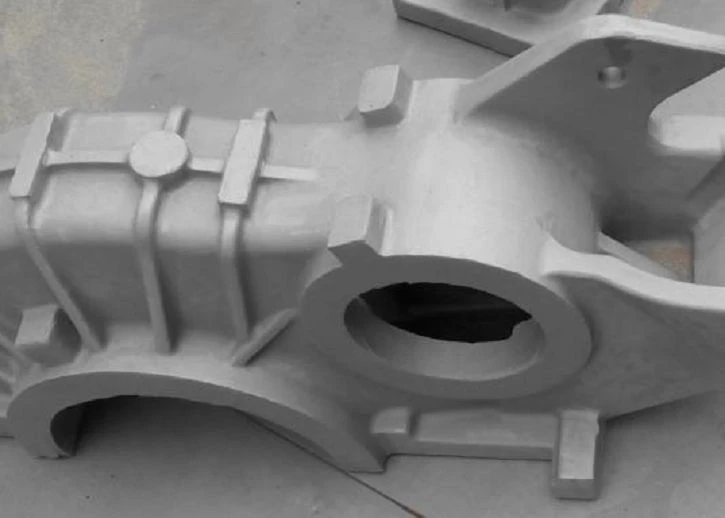
The Al Alloy Upper Casing is commonly used in various machinery. It needs to protect the internal components and provide a stable structure. The design of the upper casing should take into account factors like the mounting points, the access for maintenance, and the overall weight. We might use ribbing or other reinforcement features to increase the strength of the casing without adding too much weight.
In addition to these technical aspects, cost - effectiveness is also a crucial part of the core design. We want to make high - quality Al Alloy Castings at a reasonable cost. This means finding the right balance between the alloy selection, the casting process, and the part design. For example, using a more expensive alloy might give us better mechanical properties, but if the application doesn't really require those properties, it's a waste of money. Similarly, choosing a more complex casting process might result in a better - looking part, but if a simpler process can achieve the same functionality, we should go for the simpler one.
Quality control is also an integral part of the design process. We use a variety of inspection methods to ensure that the Al Alloy Castings meet the required standards. Non - destructive testing methods like X - ray inspection and ultrasonic testing can detect internal defects like cracks and porosity. Dimensional inspection using tools like coordinate measuring machines (CMMs) ensures that the parts have the correct size and shape.
As a supplier of Al Alloy Castings, we're always looking for ways to improve our designs and processes. We stay up - to - date with the latest research and technologies in the field. For example, new alloy compositions are being developed all the time that offer better performance and lower costs. Advanced simulation software can help us predict how the molten alloy will flow and solidify in the mold, allowing us to optimize the design before we start production.
If you're in the market for high - quality Al Alloy Castings, whether it's a standard product or a custom - designed part, we'd love to hear from you. We have the expertise and experience to provide you with the best solutions for your specific needs. Whether you need a small batch for prototyping or a large - scale production run, we can handle it. So, don't hesitate to reach out and start a conversation about your Al Alloy Casting requirements. We're here to work with you to achieve the best results.

References
- "Aluminum Casting Technology Handbook" by ASM International
- "Foundry Engineering: Principles and Practice" by John Campbell


