Hey there! As a supplier of large Ti alloy casting, I've been in the game for quite a while, and I know a thing or two about the post - processing steps for these big pieces. In this blog, I'm gonna walk you through all the key post - processing steps that are crucial for large Ti alloy castings.

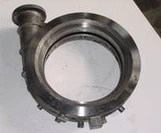
First off, let's talk about why post - processing is so important. Large Ti alloy castings, like Ti Alloy Impeller, Ti Alloy Turbine Impeller, and Ti Alloy Aerospace Investment Castings, are used in some really demanding applications. They need to meet high - quality standards in terms of mechanical properties, surface finish, and dimensional accuracy. Post - processing helps us achieve these requirements.
1. Removal of Gating and Riser Systems
Once the casting is solidified, the first step is to get rid of the gating and riser systems. These are the channels and reservoirs that were used to feed the molten titanium alloy into the mold. They're not part of the final product, so they gotta go.
We usually use cutting methods like abrasive cutting or plasma cutting. Abrasive cutting is great because it gives a relatively clean cut, but it can be a bit slow for large - scale parts. Plasma cutting, on the other hand, is faster, but it might leave a bit more of a rough edge. After cutting, we use grinding to smooth out the areas where the gating and risers were attached. This ensures that the surface of the casting is as smooth as possible, which is important for both the aesthetics and the functionality of the part.
2. Heat Treatment
Heat treatment is a super important step in post - processing large Ti alloy castings. It helps to improve the mechanical properties of the titanium alloy, like its strength, toughness, and hardness.
There are different types of heat treatments we can use. One common one is solution treatment followed by aging. In solution treatment, we heat the casting to a specific temperature and hold it there for a certain period. This allows the alloying elements to dissolve uniformly in the titanium matrix. Then, we quickly cool it down. After that, we perform the aging process, where we heat the casting to a lower temperature and hold it again. This causes the alloying elements to precipitate out in a controlled way, which strengthens the material.
Another type of heat treatment is annealing. Annealing is used to relieve internal stresses in the casting that were generated during the solidification process. By heating the casting to a suitable temperature and then slowly cooling it, we can reduce these stresses and improve the dimensional stability of the part.
3. Machining
Machining is essential to achieve the precise dimensions and surface finish required for large Ti alloy castings. We use various machining processes like turning, milling, and drilling.
Turning is used to create cylindrical surfaces on the casting. For example, if we're making a shaft - like Ti alloy part, turning can be used to get the right diameter and surface finish. Milling, on the other hand, is great for creating flat surfaces, slots, and complex shapes. We can use different types of milling cutters to achieve different geometries. Drilling is used to create holes in the casting, which might be needed for assembly or other functions.
One of the challenges with machining Ti alloy is its low thermal conductivity. This means that a lot of heat can build up during the machining process, which can cause tool wear and affect the surface quality of the casting. To deal with this, we use special cutting tools and coolants. The coolants help to dissipate the heat and lubricate the cutting process, which improves the tool life and the quality of the machined surface.
4. Surface Finishing
The surface finish of a large Ti alloy casting is important for both its appearance and its performance. There are several surface - finishing techniques we can use.
One of the most common methods is sandblasting. Sandblasting involves shooting fine sand particles at high speed onto the surface of the casting. This helps to remove any remaining surface impurities, like oxides or scale, and also gives the surface a uniform texture. It can improve the adhesion of coatings if we plan to apply any later.
Polishing is another technique used for surface finishing. We can use different grades of abrasive papers or polishing compounds to achieve a smooth and shiny surface. Polishing is often used for parts that are visible or require a high - quality finish, like some aerospace components.
We also might apply coatings to the surface of the Ti alloy casting. Coatings can provide additional protection against corrosion, wear, and oxidation. There are different types of coatings available, such as ceramic coatings and organic coatings. The choice of coating depends on the specific application and requirements of the part.
5. Inspection and Testing
After all the post - processing steps are done, it's time to make sure that the large Ti alloy casting meets all the quality standards. We use a variety of inspection and testing methods.
Non - destructive testing (NDT) is one of the key methods. Ultrasonic testing is used to detect internal defects, like cracks or porosity, in the casting. It works by sending ultrasonic waves through the material and analyzing the reflections. If there's a defect, the ultrasonic waves will be reflected differently, and we can detect it on the testing equipment.
Dye penetrant testing is used to detect surface - opening defects. We apply a colored dye to the surface of the casting, let it soak in for a while, and then remove the excess. Then, we apply a developer, which makes the defects visible as bright red or fluorescent lines.

In addition to NDT, we also perform dimensional inspection. We use tools like calipers, micrometers, and coordinate measuring machines (CMMs) to check if the casting meets the specified dimensions. This is crucial to ensure that the part will fit properly in its intended application.
6. Assembly and Packaging
Once the casting has passed all the inspections and tests, we move on to the assembly and packaging stage. If the casting is part of a larger assembly, we need to make sure that all the components fit together correctly. We might need to perform some minor adjustments or machining to ensure a proper fit.
After assembly, we carefully package the large Ti alloy casting to protect it during transportation. We use appropriate packaging materials, like foam padding and wooden crates, to prevent any damage.
As a supplier of large Ti alloy castings, I'm really proud of the high - quality products we can offer. Our post - processing steps are designed to ensure that every casting meets the strictest quality standards. If you're in the market for large Ti alloy castings, whether it's a Ti Alloy Impeller, Ti Alloy Turbine Impeller, or Ti Alloy Aerospace Investment Castings, we'd love to talk to you. Reach out to us to discuss your specific requirements and let's work together to get you the perfect casting for your application.
References
-ASM Handbook Volume 15: Casting, ASM International
-Welding and Joining of Titanium Alloys, John Wiley & Sons
-Titanium: A Technical Guide, ASM International